

Coffee Machine Liquid Level Sensing Application Guide | Water Shortage Detection & Non-Contact Sensing Design
Coffee Machine Water Tank & Water Level Detection Application Guide
Coffee Machines Need to Know Whether There Is Enough Water
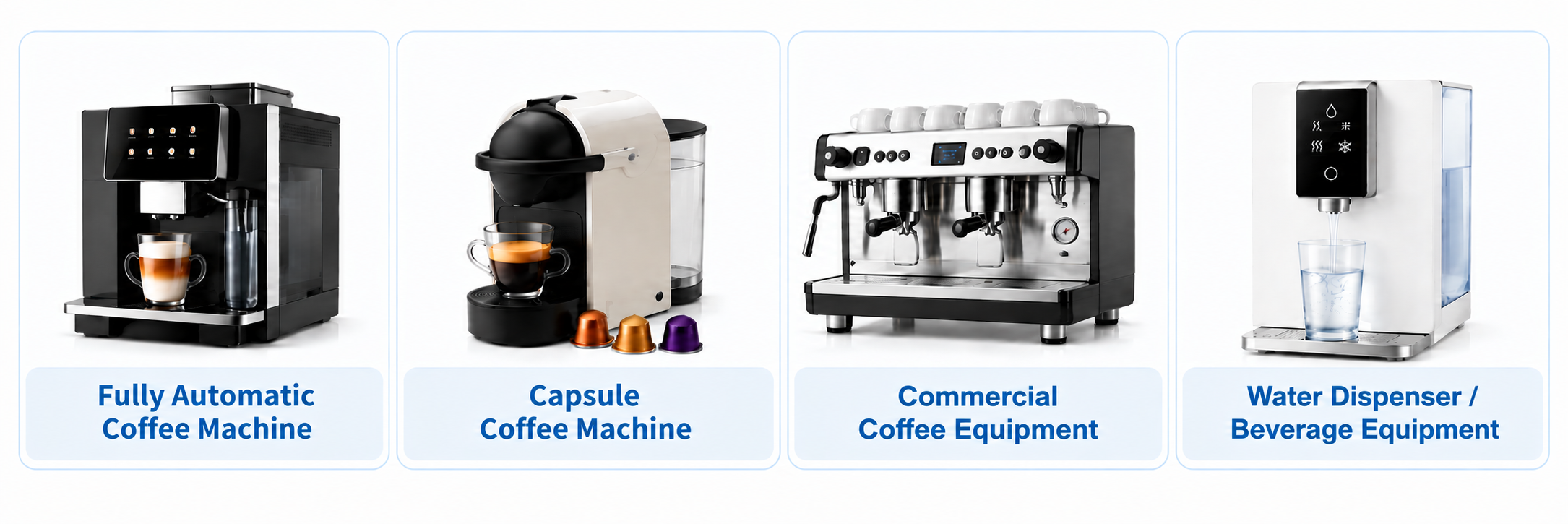
Fully automatic, capsule, and commercial coffee machines need reliable water tank status detection to prevent dry-running pumps, insufficient water supply, or interrupted brewing cycles. In many products, detecting “low water / water present” is more practical than continuously measuring the exact water level.
Non-Contact Sensing Helps Reduce Cleaning and Contamination Concerns
When the sensor can be mounted outside the water tank, it avoids direct contact with drinking water and helps reduce reliability issues caused by scale buildup and cleaning.
System Flow
Recommended Sensing Solutions
Depending on the water tank material and installation method, non-contact liquid level modules, optical solutions, or capacitive sensing can be evaluated. For sensing through the tank wall, actual testing should verify the effects of wall thickness, transparency, curvature, sensor contact, and scale buildup on signal performance.
Non-Contact Liquid Level Module
Suitable for detecting a defined liquid level point from outside the tank while reducing the need for direct contact with water.
Optical Solution
Water level or liquid presence can be evaluated according to tank transparency, surface condition, and optical path design.
Capacitive Solution
Detects changes in dielectric properties through the tank wall. Actual performance should be validated with the target material and wall thickness.
Design Considerations
Selection / Sensing Direction
| Application Requirement | Recommended Direction |
|---|---|
| Low-water detection only | Single-point liquid level sensing |
| Multiple water level stages required | Multi-point sensing or continuous measurement |
| Sensor must not contact water | External / non-contact sensing solution |
Suitable Applications
Need Help Evaluating a Coffee Machine Water Level Detection Solution?
Provide the water tank material, wall thickness, target liquid level, and available installation space, and OncQue can help evaluate a suitable liquid level detection approach.
CONTACT ONCQUE