
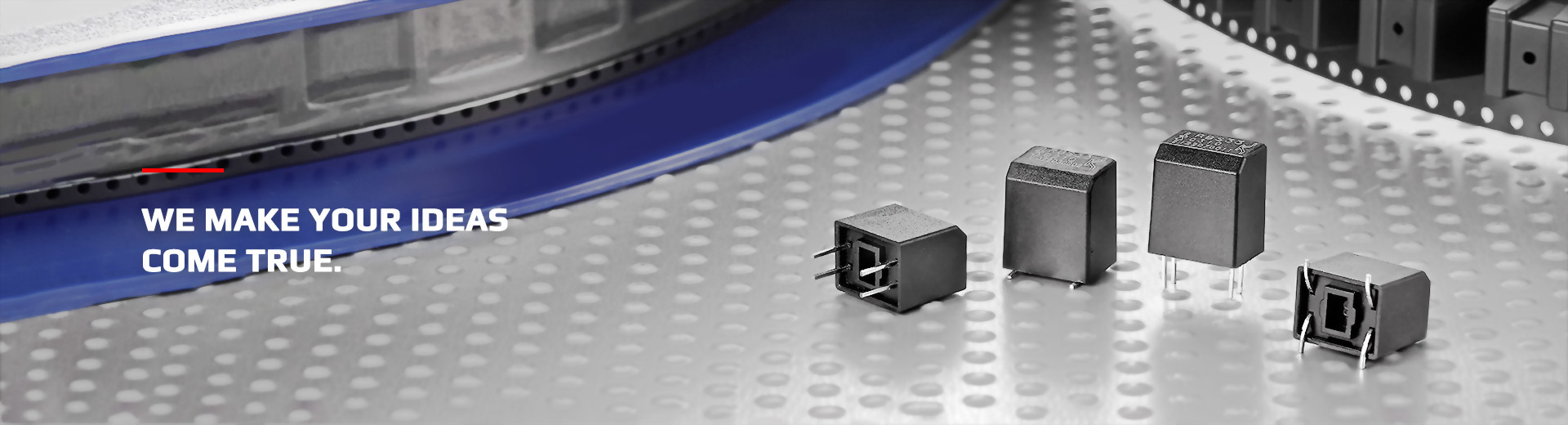

What Is an Optical Ball Switch?
An optical ball switch is a tilt or orientation sensing device that combines a ball mechanism with optical detection technology.
When a product tilts, tips over, or changes orientation, the internal ball moves under gravity and changes whether the internal optical path is blocked or transmitted. Based on the change in the optical receiver signal, the circuit can determine whether the device has reached the preset trigger condition and output the corresponding ON/OFF signal.
Because the sensing process does not require the metal ball to directly form an electrical contact, the design can reduce the risks associated with contact wear, oxidation, and unstable contact. It is therefore suitable for products with higher requirements for service life, signal stability, and reliability.
How Does an Optical Ball Switch Work?
An optical ball switch typically contains the following core components:
Preset trigger angle: Gravity causes the ball to move and change the optical path. The optical receiver detects the signal difference and converts it into a clear ON/OFF output.

Optical Ball Switch Working Principle
What Is the Difference Between Optical and Mechanical Ball Switches?
A conventional mechanical ball switch uses a metal ball to directly contact conductive terminals, thereby turning the circuit ON or OFF. An optical ball switch instead uses the change in ball position to alter the internal optical signal, rather than making the ball itself carry the electrical conduction function.
| Comparison Item | Optical Ball Switch | Mechanical Ball Switch |
|---|---|---|
| Detection Principle | The ball changes the optical path | The ball directly contacts the terminals |
| Contact Type | Non-contact optical sensing | Mechanical contact |
| Contact Wear | Lower | Contact wear must be considered |
| Oxidation Risk | Lower | May be affected by contact oxidation |
| Signal Stability | Suitable for high-stability requirements | Depends on contacts and operating environment |
| Power Requirement | Usually requires a power supply | Some models do not require power |
| Circuit Design | Requires optical signal circuitry | Relatively simple structure |
| Suitable Applications | High-reliability, long-life designs | General ON/OFF tilt detection |
6 Key Features of an Optical Ball Switch
Non-Contact Optical Detection
The ball changes the optical path instead of directly forming an electrical contact, helping reduce contact friction and wear.
Reduced Risk of Contact Oxidation
Optical sensing helps reduce unstable signals caused by oxidation, contamination, or changes in contact resistance.
Clear ON/OFF Signal
A clear output allows the main control system to identify normal, tilted, or tip-over conditions easily.
Suitable for Long-Life Applications
Sensing does not depend entirely on repeated conduction through metal contacts, making it suitable for frequent operation and long product life cycles.
Multiple Trigger Angle Options
Different tilt angles and mounting orientations can be selected to match the actual equipment posture and sensing requirement.
Suitable for Safety Protection
It can detect abnormal tilt, tip-over, or orientation changes and trigger power cutoff, alarms, shutdown, or other protection mechanisms.
Common Applications of Optical Ball Switches
Optical ball switches can be used in products that require tilt, tip-over, orientation, or abnormal-movement detection. Common applications include:
Home Appliance Safety
Used in heaters, fans, air purifiers, dehumidifiers, and other appliances to trigger power cutoff or warnings when abnormal tilt or tip-over occurs.

Industrial Equipment
Suitable for industrial control modules, equipment posture monitoring, and machine tip-over detection as a basis for abnormal-position detection or safety shutdown.

IoT & Smart Devices
Can be integrated into smart appliances, remote monitoring equipment, and asset-tracking devices to detect orientation or abnormal tilt.

Portable Equipment
Suitable for handheld instruments, portable electronics, and mobile equipment to detect operating direction, overturning, or abnormal orientation.

Tamper & Abnormal Movement Detection
When equipment is moved, removed, or its mounting angle changes, the switch can be used to trigger a tamper signal or safety alarm.

Medical & Care Equipment
Applicable to medical carts, mobile instruments, and safety devices to detect abnormal tilt, tip-over, or orientation changes.

What Should Be Considered When Selecting an Optical Ball Switch?
Component selection involves more than checking dimensions. Engineers should evaluate the following nine items:
Which Products Are Suitable for Optical Ball Switches?
Consider an Optical Ball Switch When:
- The product requires tilt or tip-over detection
- A clear ON/OFF signal is required
- A mercury switch should not be used
- Long contact life is important
- The design should reduce contact oxidation and wear
- Long-term stable operation is required
- The product includes a safety protection function
- Mechanical contacts tend to generate unstable signals in the operating environment
When Should You Consider MEMS?
If a product requires continuous angle measurement, multi-axis orientation analysis, or acceleration data, a MEMS accelerometer can be evaluated instead.
If the requirement is simply to determine whether a product has tilted, tipped over, or reached a specified angle, an optical ball switch provides a simpler and easier-to-integrate solution.
Frequently Asked Questions
Q: Does an optical ball switch require power?
Usually, yes. Because the device contains optical emitting and receiving elements, the appropriate operating voltage must be supplied according to the product specification.
Q: Does an optical ball switch have no mechanical movement at all?
No. The device still contains a ball that moves under gravity. However, the signal is detected mainly through changes in the optical path rather than by using the ball to form a direct electrical contact.
Q: Can an optical ball switch replace a mercury switch?
In many tilt, tip-over, and safety-protection applications, it can serve as a mercury-free alternative. Trigger angle, mounting orientation, output logic, dimensions, and electrical conditions should still be compared.
Q: Can vibration affect an optical ball switch?
The ball may move temporarily due to vibration. Suitable mechanical design, signal filtering, or firmware debounce is recommended according to the application environment.
Q: How should I choose between an optical ball switch and a MEMS sensor?
For simple tilt, tip-over, or ON/OFF judgment, an optical ball switch is easier to integrate. For continuous angle, multi-axis orientation, or acceleration measurement, a MEMS accelerometer is generally more suitable.
Conclusion
An optical ball switch combines a ball mechanism with optical detection principles. When equipment tilts or tips over, the internal ball changes the optical path, causing the circuit to output a clear ON/OFF signal.
Compared with conventional mechanical ball switches, the optical design can reduce the risks of contact wear, oxidation, and unstable contact, making it suitable for products with higher requirements for service life, reliability, and signal stability.
During component selection, the trigger angle, mounting orientation, power-supply conditions, output format, vibration environment, and PCB space should still be confirmed. Real-product testing is also recommended.
Looking for an Optical Ball Switch Solution?
Provide your product requirements and the OncQue team can assist with model selection, trigger-angle evaluation, and application discussions.
- Optical ball switch model recommendations
- Tilt-angle selection discussions
- Tip-over safety application recommendations
- PCB mounting and signal-integration discussions
- Customized tilt-sensing solutions