
Tilt Angle Detection Module
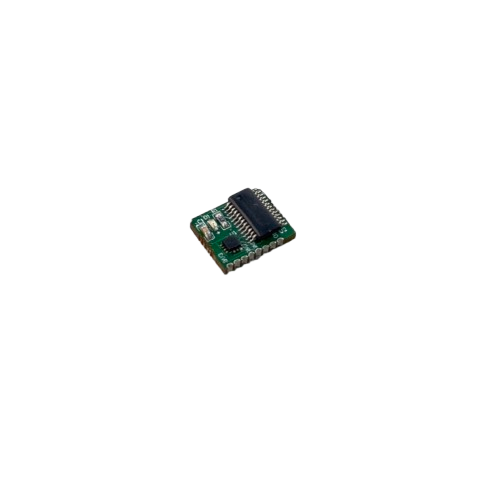
Function: Detecting a 45° tilt from the horizontal position
Tilt Angle Detection Module
● Functions :
The module is factory-preset to detect a 45° tilt from the horizontal position and is ready for immediate use.
Users may also adjust the detection angle via commands to meet specific application requirements.
The system continuously monitors the device orientation and, once the preset angle condition is reached,
automatically completes the judgment and outputs the corresponding signal to promptly activate safety protection or control mechanisms.
The Three-Axis Accelerometer Angle Module is a sensing device designed for angle, centrifugal force, and gravity detection.
It is composed of integrated sensing components and can be configured via computer software to support function planning and output evaluation.
For customer integration, the module adopts a stamp-hole (castellated) design, enabling convenient PCB layout and soldering.
● Dimensions (Unit: mm, Tolerance: ±0.5 mm):
1. Maximum overall dimensions: 12.65 (L) × 10.15 (W) × 3.2 (H)
2. Pin pitch: 2.54 mm
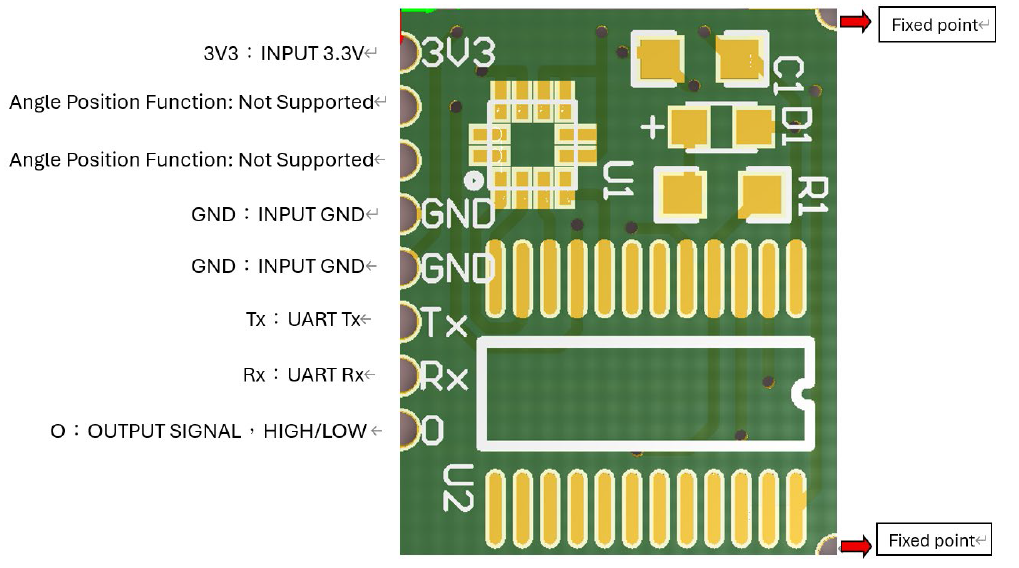
● Pin position definition:
● Command Description:
For detailed command information and
configuration instructions, please contact OncQue Corporation’s sales or
purchasing representative for full support.
● Applications :
1. Industrial Automation: Detection requirements can be adjusted through command operations.
2. Home Appliances: Applied in tip-over safety protection systems.
3. Construction Industry: Used for building tilt monitoring.
4. Aerospace: Applied in gravity and attitude detection.
5. Transportation Vehicles: Used for acceleration and motion detection.
● Features
1. Configurable Operation: Detection requirements can be adjusted through command operations.
2. Wide Application Range: Suitable for industrial automation, home appliances, network equipment, and various sensing environments.
3. Data Processing: Outputs processed detection results directly, reducing the user’s need for additional computation or judgment.